Showing posts with label Fractions. Show all posts

Rinorm Austin's Fraction Post

Tuesday, May 12, 2009
Adding Fractions

When you add fractions you need to find the lowest common denominator. The easiest way to do that is to multiply the two denominators.

2/3 + 1/8= 16/24 + 3/24= 19/24

1/4 + 3/5= 5/20 + 12/20= 17/24

1 3/4 + 2 1/5= 3

You add the 2 whole numbers first.

3/4 + 1/5= 15/20 + 4/20= 19/20

After you add the two fractions you get the answer.

3 9/20


Subtracting Fractions

When you subtract fractions you need to find the lowest common denominator. The easiest way to do that is to multiply the two denominators.

13/15 - 4/5= 13/15 - 12/15= 1/15

4/5 - 1/2= 8/10 - 5/10= 3/10

2 2/3 - 1 1/3=1

You subtract the 2 whole numbers first.

2/3 - 1/3= 1/3

After you subtract the two fractions you get the answer.


Multiplying Fractions

When you multiply fractions, you multiply both the denominators and numerators. If theres a mixed fraction, you turn it into a improper fraction and work from there.

3/4 x 1/2 x 6/7= 18/56= 9/28

As you can see I have simplified the answer to the lowest terms possible.

6/7 x 2/3= 12/21= 4/7

4 1/2 x 1/3= 9/2 x 1/3= 9/6= 1 3/6= 1 1/2


Dividing Fractions

When you divide fractions you use a recipical.
I dont know how to do it on this mac because i dont have paint so look at the other students work :)


Erika's last fraction post

Skills Assignment 4: Reciprocal

Saturday, May 9, 2009
On Tuesday, Mr Harbeck assigned us yet another skills blog post. For this post we have to define the word reciprocal, explain how it's used in math, and find at least 4 different ways.

RECIPROCAL: Reffered to multiplicative inverse. When 1 is divided by x, multiplyed by x, it will gived the product of 1.

Zero does not have a reciprocal.

How reciprocal is used in math: Reciprocal is quicker and easier than dividing fractions. Reciprocal is also used when you are doing ratio tables.

What is the reciprocal of 3/1? It's 1/3, we just flip the numerators and denominators.

EXAMPLES:


The ratio table
Here, I'll show you 3/4 divided by 2/5 using a ratio table.


QUESTIONS:
1) 3/4 divided by 3/5
This question means... How many groups of 3/5 are in 3/4?
The reciprocal of 3/5 is 5/3, and the reciprocal of 3/4 is 4/3.


The answer is going to be more than 1 because 3/4 is larger than 3/5.

2) 3/5 divided by 3/4
This question means... How many groups of 3/4 are in 3/5?
The reciprocal of 3/4 is 4/3, and the reciprocal of 3/5 is 5/3.


The answer is going to be less than 1 because 3/5 is smaller than 3/4.

Fractions Post

Liem's Last Fraction Post

Friday, May 8, 2009
FRACTIONS

Okay! We are almost done doing fractions, and now we have to review what we learned during the course of Fractions!

Okay first, what the heck is a fraction? We been doing this for weeks and we should be able to explain what a fraction is. A fraction has a numerator and a denominator, the numerator shows how many parts or pieces you have and the denominator expresses how many equal parts there are in a whole. There are 3 types of Fractions, an improper fraction, mixed number and a proper fraction. For example I will show you a picture of a mixed number.
Now I'll explain how to add fractions, subtract, multiply and even divide them! First of all lets do Adding Fractions!
Adding Fractions: When adding fractions, you must have same size equal pieces! To do that you must find a common denominator or cross multiply.. Heres are 3 examples of adding fractions:Remember to also simplify your answer but since 7 is a prime thats about it for the answer. Remember if you answer is a improper fraction, you must simplify it to a mixed number.
Okay lets do another example..
Since the other denominator is 4, you don't have to do anything to it. Also try thinking it like money! Now for my final example(:
Okay now for Subtracting Fractions: Subtracting Fractions is like the same thing as adding but your just doing the opposite. You also need to find a common denominator when your subtracting, then you can subtract your fractions.
Now for another example:
Now for another example with mixed numbers:
Now for multiplying fractions! It's very easy, you just need to remember multiply the numerator and denominator and simplify after! When multiplying mixed numbers just change them to improper and do the same steps from before!
Heres an example: Heres another example: Heres another example with mixed numbers:
Now for division! There are three ways you can divide fractions. First of all, you can draw a picture to represent the fractions and divide them but it takes time. Another thing you can do is make a ratio table. To use the ratio table, we place the fraction that is being divided on the left side of the table, and the divisor fraction on the right side of the table. Then you mutliply or divide to make the fraction on the right a whole number. And you will have your answer. You can also use the reciprocal, which is less time consuming. All you have to do turn the second fraction upside down, and multiply.
Now for 3 examples of dividing fractions:


And finally Reciprocal..
Now for 2 word problems:


Thanks for viewing my post! Comment and tell me if I made any mistakes, well bye!

Skills Reciprocal

For our skills post we had to look up the word Reciprocal. Reciprocal means; A number related to another in such a way that when its multiplied their product is one or you can called it Multiplicative Inverse.

We can use this and other techniques to get answers to our questions.
Here is an example:

Now I'll show you 3 ways I can do 3/4 divided by 3/5. First I'll show you with a ratio table

You can also estimate your answer so you know roughly where its around. Ask yourself how many groups of 3/4's are in 3/5's? Less than 1 or more than 1. Its less than one.

And heres an example of reciprocal.

Skills Assignment #4

Wednesday, May 6, 2009
Today in Skills, we have one more skill post and we have to find at least 4-5 different ways and what is the meaning of Reciprocal. So I got 4 different ways, I'll show you it in pictures. Here is one way.

Reciprocal: Also called Multiplicative inverse Mathematics. the ratio of unity to a given quantity or expression; that by which the given quantity or expression is multiplied to produce unity

The Ratio table!


Theirs Also another step with Ratio but its kinda confusing on this. You just change the Part R (N and D backwards ) Like 3/4 and you times for divide like divide by 3 and times 4

Next is pictures!


K well this is my last one and I think this will be the easy one! Its call something in Reciprocal.

Pictures:


Okay that's all the things I know how to find the answers! Sorry if I might get some wrong showing!

Skills Assignment 3; Multiplying Fractions

Tuesday, May 5, 2009
Last week Mr Harbeck assigned us our last skills assignment post, we were asked to explain if 2/5 of 3/4 are the same as 3/4 of 2/3 are actually the same just the fractions are switched around. Well let's prove it with pictures if 2/5 of 3/4 are the same as 3/4 of 2/3.
2/5 OF 3/4


3/4 OF 2/3


So basically they are the same.

Skills Assignment 4: Reciprocal

Today, we were assigned yet another blog post. We have to define the word reciprocal, explain how it's used in math, use reciprocal in 2 questions (3/4 divided by 2/5 and 2/5 divided by 3/4) and guess if it's either more than or less than one.

Definition:
In mathematics, the reciprocal can be referred to multiplicative inverse. When 1 is divided by x, multiplied by x, it will give the product of 1.

In general, the fraction's reciprocal is attained by alternating the numerator and the denominator.

How is it used in math?
Using reciprocal is easier and quicker than dividing the fraction.  It's used when you are doing ratio tables. We use the denominator to multiply the fraction, then divide it by the numerator to make a whole number. 

Guesstimate:
3/4  / 2/5. I think it's more than 1.
2/5 / 3/4. I think it's more than 1.
 
Examples:
3/4 divided by 2/5.                                                                                                                                                                                                                                                                                                                       
As you can see, we used reciprocal to get a whole number; we used the denominator (5) to multiply the fraction, then divided it by the numerator (2). What you do on one side of the ratio table, you have to do the same thing to the other. But, we weren't able to divide so we had to figure out how many times does 4 goes into 15. Then you'll have your answer. 


Again, we did the same thing as the first question.

Skills: Reciprocal

Today, we were assigned to do another blog post. We have to put the definition of the word reciprocal, explain how it's used in mathematics and show 2 examples.

Reciprocal, also called multiplicative inverse, is a number that you multiply so that the result equals 1. The easiest way to find it is to just flip the fraction over.

We use reciprocal or multiplicative inverse in math because it is faster, quicker and easier to understand. it can be used in a ratio table.

Example:

3/4 divided by 3/5
This question means - how many groups of 3/5 are in 3/4?
The reciprocal of 3/4 is 4/3 and the reciprocal of 3/5 is 5/3.

The answer is going to be more than 1 because 3/4 is larger than 3/5.
The ratio table:


3/5 divided by 3/3
This question means - how many groups of 3/4 are in 3/5?
The reciprocal of 3/5 is 5/3 and the reciprocal of 3/4 is 4/3.

The answer is going to be less than 1 because 3/5 is smaller than 3/4.
The ratio table:

Multiplying Fractions

Thursday, April 30, 2009

Multiplying Fractions

Wednesday, April 29, 2009

Math multiplying fractions

Math homework Avery's and Vincent's

yesterday we had a homework in math and we were suppose to do it in groups of 2. So here are the questions and answer.

Multiplying Fractions

Multiplying Fractions

Today in Math class, Mr. Harbeck gave us an assignment. He gave us a sheet of paper with word problems. You and a partner are supposed to answer all of the word problems and put it in Google documents, a picture or just blogger and send it to your partner. Here's our Google presentation:

Question Word Problems

We were given an assignment to complete 8 word problems with a partner and showcase the work using some blogger, google docs, etc. Below is Alex's and my presentation. Please comment, and hopefully enjoy! (:


Questions!

Tuesday, April 28, 2009
These are the answers to our questions! Done by Liem and Jowella!!


Kevin and Rinorm's post [April 28, 2009]

Kevin and Rinorm's post for fractions.

6. One week, Kristi worked 3 days at a department store for 3 1/2 hours each day. She was paid $9 per hour.
a)How many hours did Kristi work that week? Show your thinking.
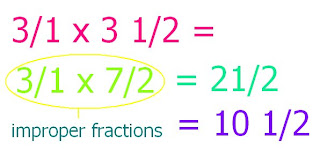
3 1/2 x 3=
I will turn the mixed number into an improper fraction now.
7/2 x 3=
21/2=
10 1/2=
Kristi worked 10 1/2 hours that week.

b)How much did Kristi earn that week?
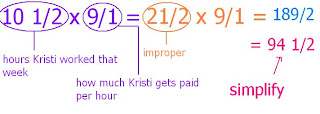
I will take the hours that she had worked this week
10 1/2 x 9=
I will turn the mixed number into an improper fraction now.
21/2 x 9=
189/2=
94 1/2=
She earned $94.50 that week.

11. Owen is 2 1/4 times as old as Robin celebrates his 8th birthday, how old will Owen be?
2 1/4 x 8=
9/4 x 8=
72/4=
18=
Owen is 18 years old when Robin turns 8.

12. The karate club is arranging a grading for its members. It takes 3 1/4 hours to test a group of 4 candidates. How long will the club need the gym in order to process 3 groups of 4 candidates each?
3 1/4 x 3=
13/4 x 3=
39/4=
9 3/4 hours=
It would take 9 3/4 hours to test 3 groups of 4 candidates.

9) The distance to Grandma's house is 4/5 of the distance to Uncle Glen's house. If Uncle Glen's house is 3 1/2 hours away, how long will it take to get to Grandma's house if you travel at the same speed?
3 1/2 x 4/5=
7/2 x 4/5=
28/10=
2 8/10=
2 4/5
It will take 2 4/5 hours to get to Grandma's house.

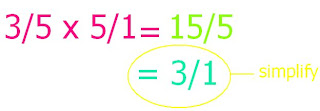
10) It takes 3/5 of a tank of gas to get to work and back each day. How much gas is used over 5 work days? Show your thinking.
3/5 x 5=
3/5 + 3/5 + 3/5 + 3/5 + 3/5=
15/5=
3
3 gas tanks is used over 5 work days.

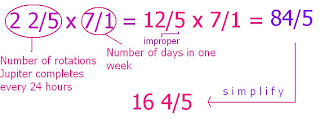
7) Jupiter completes about 2 2/5 rotations every 24 hours (an Earth day). How many rotations does Jupiter complete in one Earth week? Show your thinking.
2 2/4 x 7=
12/5 x 7=
84/5=
16 4/5
Jupiter completes 16 4/5 rotations in 1 Earth week.

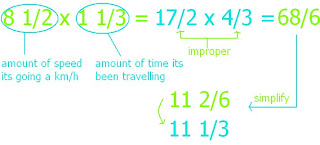
8) A sailboat is sailing at 8 1/2 km/h. If the weather conditions and the current do not change, how far will the sailboat travel in 1 1/3 hour? Show your thinking.
8 1/2 x 1 1/3=
12/2 x 4/3=
68/6=
11 2/6
The sailboat will travel 11 2/6 km in 1 1/3 hours.

Multiplying Fractions Questions

Today, Mr. Harbeck assigned us 7 questions for multiplying fractions. We had partners, and we had to create a post explaining our answers.

6. One week, Kristi worked 3 days at a department store for 3 1/2 hours each day. She was paid $9/hour.

a) How many hours did Kristi work that week? Show your thinking.
To get the answer, multiply how many days she worked by how many hours she worked each day.

Kristi worked 10 1/2 hours in that week.

b) How much did Kristi earn that week?
Kristi earned $94.50 that week.

7. Jupiter completes about 2 2/5 rotations every 24 hours (an Earth day). How many rotations does Jupiter complete in one week? Show your thinking.

To get the answer, you multiply the number of rotations Jupiter completes every 24 hours by the number of days in a week.

Jupiter completes 16 4/5 rotations in one Earth week.

8. A sailboat is sailing at 8 1/2 km/h. If the weather conditions and the current do not change, how far will the sailboat travel in 1 1/3 h? Show your thinking.


To get the answer, you multiply the amount of speed its going a km per hour by the amount of times to been travelling.

The boat will travel 11 1/3 km in 1 1/3 hours.

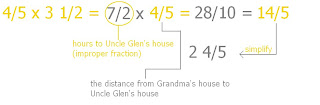
9. The distance to Grandma's house is 4/5 of the distance to Uncle Glen's house. If Uncle Glen's house is 3 1/2 hours away, how long will it take to get to Grandma's house if you travel at the same speed?

To get the answer, multiply the distance to Uncle Glen's house to Grandma's by how many hours away Uncle Glen's house is.

It will take 2 hours and 48 minutes to get to Grandma's house.

10. It takes 3/5 of a tank of gas to get to work and back each day. How much gas is used over 5 work days? Show your thinking.

To get the answer, you multiply the the fraction of how many gas is used in one day by how many days it is used for. 

3 tanks of gas are used over 5 work days.

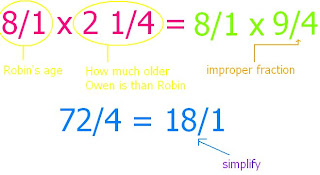
11. Owen is 2 1/4 times as old as Robin. When Robin celebrates his 8th birthday, how old will Owen be?

To get the answer, you have to multiply Robin's age (8/1) by how much older Owen is than Robin (2 1/4).

On Robin's 8th birthday, Owen will be 18 years old.

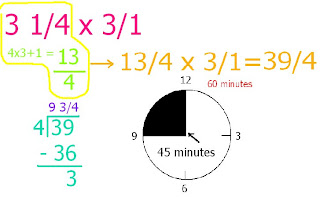
12. The karate club is arranging a grading for its members. It takes 3 1/4 hours to test a group of 4 candidates. How long will the club need the gym in order to process 3 groups of 4 candidates each?


To get the answer, you have to multiply how many hours it takes to test a group of 4 by how many groups are there in total.

It will take the club 9 hours and 45 minutes to process 3 groups of 4 candidates.