Showing posts with label Skills. Show all posts
Skills Assignment 4: Reciprocal
Saturday, May 9, 2009
On Tuesday, Mr Harbeck assigned us yet another skills blog post. For this post we have to define the word reciprocal, explain how it's used in math, and find at least 4 different ways.

RECIPROCAL: Reffered to multiplicative inverse. When 1 is divided by x, multiplyed by x, it will gived the product of 1.
Zero does not have a reciprocal.
How reciprocal is used in math: Reciprocal is quicker and easier than dividing fractions. Reciprocal is also used when you are doing ratio tables.
What is the reciprocal of 3/1? It's 1/3, we just flip the numerators and denominators.
EXAMPLES:
The ratio table
Here, I'll show you 3/4 divided by 2/5 using a ratio table.
QUESTIONS:
1) 3/4 divided by 3/5
This question means... How many groups of 3/5 are in 3/4?
The reciprocal of 3/5 is 5/3, and the reciprocal of 3/4 is 4/3.
The answer is going to be more than 1 because 3/4 is larger than 3/5.
2) 3/5 divided by 3/4
This question means... How many groups of 3/4 are in 3/5?
The reciprocal of 3/4 is 4/3, and the reciprocal of 3/5 is 5/3.

The answer is going to be less than 1 because 3/5 is smaller than 3/4.
Skills Reciprocal
Friday, May 8, 2009
For our skills post we had to look up the word Reciprocal. Reciprocal means; A number related to another in such a way that when its multiplied their product is one or you can called it Multiplicative Inverse.
We can use this and other techniques to get answers to our questions.
Here is an example:
Now I'll show you 3 ways I can do 3/4 divided by 3/5. First I'll show you with a ratio table

You can also estimate your answer so you know roughly where its around. Ask yourself how many groups of 3/4's are in 3/5's? Less than 1 or more than 1. Its less than one.
And heres an example of reciprocal.
We can use this and other techniques to get answers to our questions.
Here is an example:

Now I'll show you 3 ways I can do 3/4 divided by 3/5. First I'll show you with a ratio table

You can also estimate your answer so you know roughly where its around. Ask yourself how many groups of 3/4's are in 3/5's? Less than 1 or more than 1. Its less than one.
And heres an example of reciprocal.
Skills Assignment #4
Wednesday, May 6, 2009
Today in Skills, we have one more skill post and we have to find at least 4-5 different ways and what is the meaning of Reciprocal. So I got 4 different ways, I'll show you it in pictures. Here is one way.
Reciprocal: Also called Multiplicative inverse Mathematics. the ratio of unity to a given quantity or expression; that by which the given quantity or expression is multiplied to produce unity
The Ratio table!

Theirs Also another step with Ratio but its kinda confusing on this. You just change the Part R (N and D backwards ) Like 3/4 and you times for divide like divide by 3 and times 4
Next is pictures!

K well this is my last one and I think this will be the easy one! Its call something in Reciprocal.
Pictures:

Okay that's all the things I know how to find the answers! Sorry if I might get some wrong showing!
Reciprocal: Also called Multiplicative inverse Mathematics. the ratio of unity to a given quantity or expression; that by which the given quantity or expression is multiplied to produce unity
The Ratio table!
Theirs Also another step with Ratio but its kinda confusing on this. You just change the Part R (N and D backwards ) Like 3/4 and you times for divide like divide by 3 and times 4
Next is pictures!

K well this is my last one and I think this will be the easy one! Its call something in Reciprocal.
Pictures:
Okay that's all the things I know how to find the answers! Sorry if I might get some wrong showing!
Skills Assignment 3; Multiplying Fractions
Tuesday, May 5, 2009
Last week Mr Harbeck assigned us our last skills assignment post, we were asked to explain if 2/5 of 3/4 are the same as 3/4 of 2/3 are actually the same just the fractions are switched around. Well let's prove it with pictures if 2/5 of 3/4 are the same as 3/4 of 2/3.
Skills Assignment 4: Reciprocal
Today, we were assigned yet another blog post. We have to define the word reciprocal, explain how it's used in math, use reciprocal in 2 questions (3/4 divided by 2/5 and 2/5 divided by 3/4) and guess if it's either more than or less than one.
Definition:
In mathematics, the reciprocal can be referred to multiplicative inverse. When 1 is divided by x, multiplied by x, it will give the product of 1.
In general, the fraction's reciprocal is attained by alternating the numerator and the denominator.
How is it used in math?
Using reciprocal is easier and quicker than dividing the fraction. It's used when you are doing ratio tables. We use the denominator to multiply the fraction, then divide it by the numerator to make a whole number.
Guesstimate:
3/4 / 2/5. I think it's more than 1.
2/5 / 3/4. I think it's more than 1.
Examples:
3/4 divided by 2/5.
As you can see, we used reciprocal to get a whole number; we used the denominator (5) to multiply the fraction, then divided it by the numerator (2). What you do on one side of the ratio table, you have to do the same thing to the other. But, we weren't able to divide so we had to figure out how many times does 4 goes into 15. Then you'll have your answer.


Again, we did the same thing as the first question.
Skills: Reciprocal
Today, we were assigned to do another blog post. We have to put the definition of the word reciprocal, explain how it's used in mathematics and show 2 examples.
Reciprocal, also called multiplicative inverse, is a number that you multiply so that the result equals 1. The easiest way to find it is to just flip the fraction over.
We use reciprocal or multiplicative inverse in math because it is faster, quicker and easier to understand. it can be used in a ratio table.
Example:
3/4 divided by 3/5
This question means - how many groups of 3/5 are in 3/4?
The reciprocal of 3/4 is 4/3 and the reciprocal of 3/5 is 5/3.
The answer is going to be more than 1 because 3/4 is larger than 3/5.
The ratio table:

3/5 divided by 3/3
This question means - how many groups of 3/4 are in 3/5?
The reciprocal of 3/5 is 5/3 and the reciprocal of 3/4 is 4/3.
The answer is going to be less than 1 because 3/5 is smaller than 3/4.
The ratio table:
Reciprocal, also called multiplicative inverse, is a number that you multiply so that the result equals 1. The easiest way to find it is to just flip the fraction over.
We use reciprocal or multiplicative inverse in math because it is faster, quicker and easier to understand. it can be used in a ratio table.
Example:
3/4 divided by 3/5
This question means - how many groups of 3/5 are in 3/4?
The reciprocal of 3/4 is 4/3 and the reciprocal of 3/5 is 5/3.
The answer is going to be more than 1 because 3/4 is larger than 3/5.
The ratio table:

3/5 divided by 3/3
This question means - how many groups of 3/4 are in 3/5?
The reciprocal of 3/5 is 5/3 and the reciprocal of 3/4 is 4/3.
The answer is going to be less than 1 because 3/5 is smaller than 3/4.
The ratio table:
Skills Assignment 3
Today in Skills, Mr.Herbeck gave us an assignment. This assignment would give us 10 extra mark so I might as well do it for extra marks.
Question: Are 2/5 of 3/4 the same as 3/4 of 2/5?
Well do they look the same to you? Well lets find out by using Pictures and numbers!
1. 2/5 and 3/4

Well Since the other one is still the same, do you think I'm still going to do it? Yes but in Picture!

Well I guess their both the same. Thank you for looking at my assignment! :)
Question: Are 2/5 of 3/4 the same as 3/4 of 2/5?
Well do they look the same to you? Well lets find out by using Pictures and numbers!
1. 2/5 and 3/4

Well Since the other one is still the same, do you think I'm still going to do it? Yes but in Picture!

Well I guess their both the same. Thank you for looking at my assignment! :)
Skills Assignment #3
For our third skills assignment we had to explain if 2/5 of 3/4 the same as 3/4 and 2/5?
Okay, 2/5 of 3/4 and 3/4 of 2/5 are actually the same but the fractions are just switched around. Okay lets draw a picture of them showing how they are equal.
So I guess their the same! Thanks for viewing my assignment!!
Okay, 2/5 of 3/4 and 3/4 of 2/5 are actually the same but the fractions are just switched around. Okay lets draw a picture of them showing how they are equal.
So I guess their the same! Thanks for viewing my assignment!!
Skills: Fractions 3
In skills class, we were assigned to do another post about fractions. The question is: Are 2/5 of 3/4 the same as 3/4 of 2/5? We will find out by using pictures.
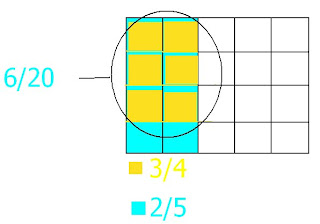
This is 2/5 of 3/4 :
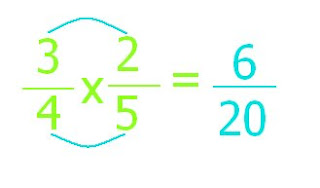
To find out how to do this you need to multiply the fractions and to do that you have to multiply the numerators and the denominators.
numerators: 2 x 3 = 6
denominators: 5 x 4 = 20
So the answer is 6/20 or when simplified: 3/10

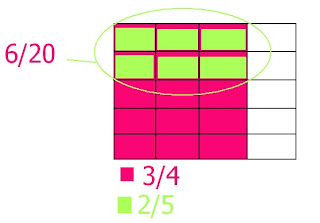
This is 3/4 of 2/5:
numerators: 3 x 2 = 6
denominators: 4 x 5 = 20

So, as you can see they're the same (:
This is 2/5 of 3/4 :
To find out how to do this you need to multiply the fractions and to do that you have to multiply the numerators and the denominators.
numerators: 2 x 3 = 6
denominators: 5 x 4 = 20
So the answer is 6/20 or when simplified: 3/10

This is 3/4 of 2/5:
numerators: 3 x 2 = 6
denominators: 4 x 5 = 20

So, as you can see they're the same (:
Skills Assignment 3
For our third post for math skills, we were assigned to explain if 2/5 of 3/4 are the same as 3/4 of 2/3. To find out, I am going to use pictures and multiplication.
2/5 of 3/4
Multiplication:

Picture:

______________________________________________________________
3/4 of 2/5:
Multiplication:

Picture:

As you can see, 2/5 of 3/4 and 3/4 of 2/5 are the same. They both are equivalent to 6/20.
Skills Post # 1
Sunday, April 26, 2009
One day In class Mr.Harbeck was teaching us about fractions and how 2 fractions can be the same, but one is more precise.
Question 1. 2/3 or 3/4

They both look the same. 2/3 is 4/6 simplified. One is more precise.
4/6 is more precise than 2/3. That is true because if you were to turn those to fractions in to decimals ... it would be.. 0.6666667 ( 2/3 ) and.. 0.66666667 ( 4/6 ).
4/6 is more precise because it has more place value.

1/4 is obviously bigger than 1/8 ... but why ?
If you look at the picture above , 1/4 is a bigger portion than 1/8. When you look at the denominator you see that 8 is bigger than 4 , so many people might think that 1/8 is larger than 1/4. But when you look at a fraction... the lower the denominator , the bigger the piece. What would you rather have.. 1 of 4 slices from a pizza or 1 of 8 slices from a pizza? 1 of 4 right? Because its cut into less pieces which makes each piece bigger.
Question 1. 2/3 or 3/4

They both look the same. 2/3 is 4/6 simplified. One is more precise.
4/6 is more precise than 2/3. That is true because if you were to turn those to fractions in to decimals ... it would be.. 0.6666667 ( 2/3 ) and.. 0.66666667 ( 4/6 ).
4/6 is more precise because it has more place value.
Question 2. 1/8 or 1/4

1/4 is obviously bigger than 1/8 ... but why ?
If you look at the picture above , 1/4 is a bigger portion than 1/8. When you look at the denominator you see that 8 is bigger than 4 , so many people might think that 1/8 is larger than 1/4. But when you look at a fraction... the lower the denominator , the bigger the piece. What would you rather have.. 1 of 4 slices from a pizza or 1 of 8 slices from a pizza? 1 of 4 right? Because its cut into less pieces which makes each piece bigger.
Skills Assignment #2
Saturday, April 25, 2009
On Thursday Mr.Herbeck gave us a skill homework. Its about Fraction, I'll show you 2 ways of finding the answer in subtracting fractions. Here is one way of finding the answer. (In subtract)
This is Borrowing

Now there is another way of finding the answer in mixed subtract fraction. Here is another way. This is call the improper fraction way.

Well those are all the way of finding the answer of mixed subtracting fractions. You can find more but I don't their is more. Well thanks for looking at my assignment! BYE!!
This is Borrowing
Now there is another way of finding the answer in mixed subtract fraction. Here is another way. This is call the improper fraction way.
Well those are all the way of finding the answer of mixed subtracting fractions. You can find more but I don't their is more. Well thanks for looking at my assignment! BYE!!
Skills : Fractions 2
In math class, we talked about subtracting fractions. To be able to subtract fractions, it has to have the same denominators. To get the same denominator you look for the lowest common denominator for example: 1/4 - 1/8, you can't subtract that because the denominators are different so you have to look for the lowest common denominator which is 8, you need to change 1/4 so the numerator is 2 and the denominator is 8. 2/8 - 1/8, is much better and you can now subtract. Mr. Harbeck also taught us how to subtract mixed fractions using two very effective techniques.
The first one is: turning it into an improper fraction, denominator x whole number + numerator = improper fraction. For example: 2 1/2 - 1 3/4 = ?, if you change it, it will be like this: 2 2/4 - 1 3/4. You can subtract 2 and 1 but you can't subtract 2 and 1 so you have to change it into an improper fraction: 10/4 - 7/4 = 3/4
The second one is: the borrowing technique, we use this when the numerator is too big. For example: 625 1/2 - 100 3/4 = ? or as an improper fraction: 1251/2 - 403 = ?, isn't that a bit more complicated? But, if you just borrow like this: ( 624 4/4 + 2/4) - 100 3/4 = ?, is much better because all you have to do is this:
Add 624 4/4 and 2/4 and the answer is 624 6/4. Then, you subtract 624 6/4 and 100 3/4 and the answer is 524 3/4.
Now, subtracting fractions are much easier whether it's improper, proper or mixed. (:
The first one is: turning it into an improper fraction, denominator x whole number + numerator = improper fraction. For example: 2 1/2 - 1 3/4 = ?, if you change it, it will be like this: 2 2/4 - 1 3/4. You can subtract 2 and 1 but you can't subtract 2 and 1 so you have to change it into an improper fraction: 10/4 - 7/4 = 3/4
The second one is: the borrowing technique, we use this when the numerator is too big. For example: 625 1/2 - 100 3/4 = ? or as an improper fraction: 1251/2 - 403 = ?, isn't that a bit more complicated? But, if you just borrow like this: ( 624 4/4 + 2/4) - 100 3/4 = ?, is much better because all you have to do is this:
Add 624 4/4 and 2/4 and the answer is 624 6/4. Then, you subtract 624 6/4 and 100 3/4 and the answer is 524 3/4.
Now, subtracting fractions are much easier whether it's improper, proper or mixed. (:
Skills Assignment #2
Saturday, April 18, 2009
On Thursday we were had an assignment in Math Skills. This time we had to make a post about subtracting fractions using 2 techniques, one is good at some times and the other is good at other times. The two ways you can subtract mixed fractions is to make them improper first then subtract. Or if the mixed numbers are too big, we can use a borrow technique.
The proper time to borrow is when one of the mixed numbers is too big. It would just be harder to make it an improper fraction first then go from there on. For example:100 2/4 - 6 3/4. Unless you want to do like 1,000 push ups, do it the easier way, borrowing. As you can see you can't take 3 with you have only 2.
Okay now I'll show the proper time to use the improper way to subtract fractions. The proper time to use fractions is when the numbers are small and when you can't take away something bigger when you have something smaller to begin with. For example:
See how you can use both ways to subtract fractions! Sometimes one is more faster than the other but you can do either one, they both work!
The proper time to borrow is when one of the mixed numbers is too big. It would just be harder to make it an improper fraction first then go from there on. For example:100 2/4 - 6 3/4. Unless you want to do like 1,000 push ups, do it the easier way, borrowing. As you can see you can't take 3 with you have only 2.

Okay now I'll show the proper time to use the improper way to subtract fractions. The proper time to use fractions is when the numbers are small and when you can't take away something bigger when you have something smaller to begin with. For example:
See how you can use both ways to subtract fractions! Sometimes one is more faster than the other but you can do either one, they both work!
SKills Post 2
Friday, April 17, 2009
Sometimes when subtracting fraction you first have to turn them into improper factions, you can also borrow from the fractions.
A good time to switch to improper factions first is when you find out you can't subtract the numerators and the fractions are small. ,
2 1/2 - 1 3/4 =
2 2/4 - 1 3/4 =
= ?
You can't subtract 3 from 2 so you have to start the question with improper factions,
2 1/2 - 1 3/4 =
5/2 - 7/4 =
10/4 - 7/4
=3/4
These questions are an example of when you need to do switch to start with improper fractions.
A good time to borrow when subtracting fractions is when the fraction are huge,
625 1/2 - 100 3/4 =
625 2/4 - 100 3/4 =
= ?
When the question ends up with 2 subtracted by 3 is a good time to borrow,
625 1/2 - 100 3/4 =
625 2/4 - 100 3/4 =
(624 + 4/4 + 2/4)
624 6/4 - 100 3/4=
= 624 9/4
The question is now solved by borrowing fractions.
You can do any subtracting question now, you can do it normally, you can borrow, or you can use improper fractions
A good time to switch to improper factions first is when you find out you can't subtract the numerators and the fractions are small. ,
2 1/2 - 1 3/4 =
2 2/4 - 1 3/4 =
= ?
You can't subtract 3 from 2 so you have to start the question with improper factions,
2 1/2 - 1 3/4 =
5/2 - 7/4 =
10/4 - 7/4
=3/4
These questions are an example of when you need to do switch to start with improper fractions.
A good time to borrow when subtracting fractions is when the fraction are huge,
625 1/2 - 100 3/4 =
625 2/4 - 100 3/4 =
= ?
When the question ends up with 2 subtracted by 3 is a good time to borrow,
625 1/2 - 100 3/4 =
625 2/4 - 100 3/4 =
(624 + 4/4 + 2/4)
624 6/4 - 100 3/4=
= 624 9/4
The question is now solved by borrowing fractions.
You can do any subtracting question now, you can do it normally, you can borrow, or you can use improper fractions
Skills Assignment 2
Sometime last week, we were assigned another assignment in Skills class. But instead, we have to make a post about subtracting fractions that should borrow, and fractions that should use improper.
The proper time to borrow is when you need to subtract the two fractions but need to use the whole number to do so or when the number is simply big. For example 12 2/11 - 4 9/11. I will explain to you by using pictures, step by step.


After you've changed the fractions, you still can't subtract but that's how it's supposed to be. So the next thing you need to do is multiply the whole number with the denominator and add the numerator (just like when you're borrowing).
The proper time to borrow is when you need to subtract the two fractions but need to use the whole number to do so or when the number is simply big. For example 12 2/11 - 4 9/11. I will explain to you by using pictures, step by step.


___________________________________________________________________
The proper time to make a fraction into an improper fraction is when the first fraction cannot be subtracted by the second fraction. For example, 6 1/2 - 1 3/4.

Now that we've subtracted the whole numbers, we need to subtract the fractions. In order to do that, we have to firstly find the common denominator. Both of the denominators fit into 4 equally, so our equivalent fractions are now 2/4 and 3/4. 3/4 stays the same because the denominator is already 4.
* To get an equivalent fraction, you have to see how many times the first denominator goes into the new denominator. Then you have to multiply how many times by the numerator. (E.g. 1/2: 4 is the new denominator. 2x4=2. 2x1=2. New fraction is 2/4.)

After you've changed the fractions, you still can't subtract but that's how it's supposed to be. So the next thing you need to do is multiply the whole number with the denominator and add the numerator (just like when you're borrowing).

Finally, all you have to do is subtract the fractions and you'll get the answer.

Skills assignment #2; Subtracting Fractions
A few weeks ago now, we were given yet another skills assignment (skills post), still having to do with fractions. But instead we have to be able to make a post about subtracting fractions that should borrow, and fractions that should be improper fractions.
The proper time to borrow is when... one of the mixed numbers is too big. We can subtract fractions to make them improper or if the mixed numbers in the mixed fractions are too big we can just borrow.
100 2/4 - 6 3/4
PICTURE:

The proper time to use the improper way is when... the numbers are small and when you can't take something larger from something smaller.
PICTURE:
Skills Assignment : Fractions
Sunday, April 12, 2009
In our Math class, Mr. Harbeck was teaching us about fractions, and how you compare them. During our Skills class, Mr. Harbeck told us to find two different ways between two fractions. We were assigned to show if the fractions were the same, smaller, or bigger. The way you find out if a fraction is bigger, smaller or the same is by using a picture, or a decimal.
The first fraction we were given was; 2/3 and 4/6. Is 2/3 bigger, smaller, or the same as 4/6? To find out, let's find the decimal of the two fractions.
DECIMAL :
First you divide 2 by 3, and you get 0.666 [repeating]. Then you divide, 4 by 6 and you get 0.666 [repeating]. So now, you know that these two fractions are the same! Another way you can say they're the same is saying that they are equivalent.
PICTURE :
The second fraction Mr. Harbeck gave us was; 1/8 and 1/4. Is 1/8 bigger, smaller or the same as 1/4? To find the answer, we do the same thing as the first one.
DECIMAL :
First, you divide 1 by 8. You get, 0.125, and when you divide 1 by 4. You get, 0.25.
This proves that 1/4, is bigger than 1/8.
PICTURE :
The first fraction we were given was; 2/3 and 4/6. Is 2/3 bigger, smaller, or the same as 4/6? To find out, let's find the decimal of the two fractions.
DECIMAL :
First you divide 2 by 3, and you get 0.666 [repeating]. Then you divide, 4 by 6 and you get 0.666 [repeating]. So now, you know that these two fractions are the same! Another way you can say they're the same is saying that they are equivalent.
PICTURE :
The second fraction Mr. Harbeck gave us was; 1/8 and 1/4. Is 1/8 bigger, smaller or the same as 1/4? To find the answer, we do the same thing as the first one.DECIMAL :
First, you divide 1 by 8. You get, 0.125, and when you divide 1 by 4. You get, 0.25.
This proves that 1/4, is bigger than 1/8.
PICTURE :
Skills post by Josh T.
My terrible thing xD.
2/3 and 4/6
two easy ways to find that they are equal :].
First look you can convert into %'s. How you can do this is you take 100 and divide it by the denominator. So you would split 100 into 3 parts and into 6 parts. When dividing 100 into 3 parts its 33.333 on going but we just say 33.3. So 1 part is 33% add another part to that and it equals 66%. 66% is when you have 2 thirds of a number. Finally you do the same thing to the 4/6 each part is around 16.6% on going so when you add two together its about 33.3 % 2/6 is equal to 1/3 add 2 to 2/6 which is another 30% and you have 2/3 and 4/6 being the same number [ 66% ].
Another way is simplying.
all you have to do is find out if you are able to half the numerator and denominator with it still being a whole number.
When you half 4/6 4 divided by 2 and 6 divided by 2 it is equal to 2/3 which is obviously equal to 2/3.
2 different ways to find which is greater between
1/8 and 1/4
For this you are definetly able to convert into %'s.
you know that 1/4 is 1 quarter of 100. Divide 100 by 4 and that equals 25%. 1/8 is half of 1/4 so that means that it is half of 25. 1/8 is equal to 12.5% which means for sure that 1/4 is bigger.
In decimals this may be a little confusing for some people
0.125 [1/8]
0.25 [1/4]
as you can see the 1/8 looks bigger. But it is not. This is something called place values. here is the example.
0.125[000]
0.25[0000]
It doesnt matter how many 0's are behind it the closest place value to the whole is whats determined to find the real answer.
okay I hope this made sense.
2/3 and 4/6
two easy ways to find that they are equal :].
First look you can convert into %'s. How you can do this is you take 100 and divide it by the denominator. So you would split 100 into 3 parts and into 6 parts. When dividing 100 into 3 parts its 33.333 on going but we just say 33.3. So 1 part is 33% add another part to that and it equals 66%. 66% is when you have 2 thirds of a number. Finally you do the same thing to the 4/6 each part is around 16.6% on going so when you add two together its about 33.3 % 2/6 is equal to 1/3 add 2 to 2/6 which is another 30% and you have 2/3 and 4/6 being the same number [ 66% ].
Another way is simplying.
all you have to do is find out if you are able to half the numerator and denominator with it still being a whole number.
When you half 4/6 4 divided by 2 and 6 divided by 2 it is equal to 2/3 which is obviously equal to 2/3.
2 different ways to find which is greater between
1/8 and 1/4
For this you are definetly able to convert into %'s.
you know that 1/4 is 1 quarter of 100. Divide 100 by 4 and that equals 25%. 1/8 is half of 1/4 so that means that it is half of 25. 1/8 is equal to 12.5% which means for sure that 1/4 is bigger.
In decimals this may be a little confusing for some people
0.125 [1/8]
0.25 [1/4]
as you can see the 1/8 looks bigger. But it is not. This is something called place values. here is the example.
0.125[000]
0.25[0000]
It doesnt matter how many 0's are behind it the closest place value to the whole is whats determined to find the real answer.
okay I hope this made sense.
Subscribe to:
Posts (Atom)