Showing posts with label Nikki817. Show all posts

Percent Post

Sunday, May 31, 2009
Part A

1) 245% of $356.80

The easiest way to solve this question is to use a ratio table. The question is what is 245% of $365.80? $365.80 is the whole or 100% and 245% what you are trying to find in the whole. Here is a picture of what it looks like to solve it with a ratio table.
The answer is $874.16.


2) 68 3/4% of 730

For this question you could also use the ratio table.
3) 360% of $129.95

I'm going to use a ratio table to solve this question.
Part B
Miguel bought a car for $4700. He made a down payment of 191/2%. How much was the down payment?


I think the easiest way to solve this question is to use a ratio table to help you solve it.


For this question you have to find 19 1/2% of $4700. To find that, the easiest is to find the value of 1%. To do that you have to divide it by 100; the answer would be 47. The next thing you do is multiply 19.50(same as 19 1/2) by 47. The answer you get is 916.50.


About 5.6% of Canadians have Type 2 Diabetes. If Canada's population is 32 million, about how many Canadians have this condition.


For this question you have to find out the amount of Canadians have Type 2 Diabetes. To do that you have to find 5.6% of 32 million. First you have to divide 100 by 100 which gives you 1 and then multiply 1 with 5.6. You also do that to 32 million, you divide it with 100. It gives you 32000 and then you multiply it with 5.6. The result is 179 000 and that is the answer.

Nikki Lopez's Last Fraction Post

Friday, May 8, 2009
Hey everyone! Mr. Harbeck told us to make a fraction review post, so this is mine. In my post you'll learn how to add, subtract, multiply and divide fractions. Such as mixed, improper and proper fractions.

What is a Fraction?
A number ususally expressed in a form a/b. A fraction has a numerator and a denominator. The numerator is the number on top of the and shows how many parts you have. The denominator is the number at the bottom and it shows how many equal parts there are in the whole.

eg.


Now that you know what a fraction is, you should also know the different kinds of fractions there are. The different kinds of fractions are proper, improper and mixed. A proper fraction is the one I showed above^^.


An improper fraction is when the mumerator is larger than the denominator. An example would be 5/3. You could convert them into mixed fractions. A mixed fraction is a whole number and a fraction combined. An example would be 1 2/3.
You convert mixed fractions into improper fractions by multiplying the denominator with the whole number and adding the numerator. The result would be the numerator and the denominator stays the same as the denominator of the mixed fraction.


Adding and Subtracting Fractions

To add fractions, you have to make sure that you have the same denominator. If you don't then use just find the least common multiple of the denominators or you cross multiply.

To subtract fractions have the same steps as adding fractions, instead you subtract.


Here are my questions.


Multiplying Fractions

Multiplying fractions is really simple. All you got to do is to multiply the numerators and multiply the denominators. Then simplify.


Here are 2 examples.


Dividing Fractions

Here a lot of ways to multiply fractions one way is to multiply the first fraction the second fractions reciprocal. You could also use the secret fraction solving tool called the Ratio Table. It works every time.


This is how you divide proper fractions.


First picture:
Second picture:This is how you divide mixed fractions.Word Problems


Sorry if I made any mistakes.

Multiplying Fractions

Wednesday, April 29, 2009

Scribe Post for April 14/09

Tuesday, April 14, 2009
Today in class, Mr. Harbeck corrected our homework from yesterday. For homework we had 4 questions and 3 word problems. I'm here to show you how to solve the 4 questions and Joysie will show you how to solve the word problems on another post.

First one is 5/9 + 1/3. I'll show you my way of solving it.
My way of solving it is cross multiplying the numbers.


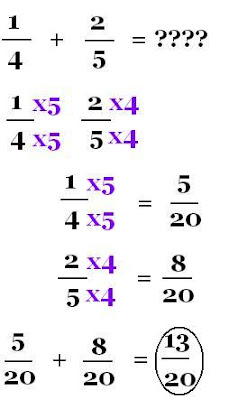
The 2nd question is 1/4 + 2/5.


Third question is 3/8 + 2/3.


Finally, the last question is 7/15 + 2/5.


If you still don't understand how to add fractions click here.

Sorry, if I made a mistake. If I did just leave a comment.

The next scribe is Kevin!!!

Pythagoras

Saturday, February 21, 2009
This post is about a guy named Pythagoras. Pythagoras is an uber smart greek mathematician. Nobody found any evidence that he existed. Before I explain what Pythagoras did, here are the pictures and meanings of these artifacts.


Legs - They are shorter than the hypotenuse and creates the right the angle of the triangle. Each triangle has two legs.

Hypotenuse - It's the longest side of the of the right triangle. It is also across from the right angle.

R.A.T - Right Angle Triangle

Greek - A nation coming from Greece.
Theorem - A formula that can be prooved.

What Pythagoras did was he made a theorem. It was called the Pythegorean Theorem. It is the statement that the sum of the two small squares (a and b) equals the big square (c). All those artifacts are connected to the Pythagorean Theorem. The formula for the theorem is a²+b²=c².


We care about Pythagoras in Grade 8 math because Pythagoras made the formula for the theorem.

Here the two word problems I solved:


The Formula

c²-a²=b²
10²-8²=b²
100-64=b²
36=b²
√36=b
6=b
6x2=12mm


A checkerboard is made of 64 small squares that each have a dimension of 3 cm x 3 cm. The 64 small squares are arranged in eight rows of eight.

a) What is the length of the diagonal of a small square? Give your answer to the nearest tenth of a centimeter.

For this one we have to solve for c. We already know the length and width. They are a and b. Now we just have to use a²+b²=c².


b) What is the length of the diagonal of the board? Give your answer to the nearest tenth of a centimeter?


This is a video of Giselle, Joysielyn, Liem and I explaining the Pythagorean Theorem using squares.


Part 2


Scribe Post for January 27/09

Tuesday, January 27, 2009
Hi everyone! Today in class we did more word problems on pg. 47 and pg. 48 in our lavender booklets. I'm here to show you how to solve 2 problems on each page.

Pg. 47

2. Suppose you have $40 and earn $7 per hour. How many hours must yoiu work until you have $131?

First you must have a Simple Sentence Answer and showing what the variable equals.


3. Valley Video charges a $15 annual fee plus $3 per movie for rentals. Last year, Jennifer spent $99 at the store. How many movies did she rent?


Pg. 48

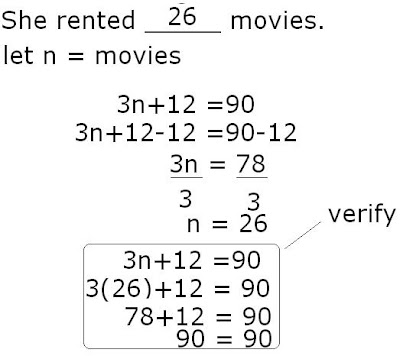
3. Valley Video charges a $12 annual fee plus $3 per movie for rentals. Last year, Jennifer spent $90 at the store. How many movies did she rent?


5. Suppose you are a salesperson for Quark Computer Company. Each month you earn $400 plus one sixth for your sales. What amount must you sell this month to earn $2000?


Sorry if I made any mistakes!

The next scribe is Vincent!

Pay it Forward

Saturday, January 3, 2009
Before the winter break all the grade eight students watched a movie called Pay it Forward. It was about a young boy trying to make the world a better place. After the movie, the grade eight students were assigned to do an act of kindness. I decided to shovel with Giselle,Eunice and Jowella. We decided to help Eunice's neighbor. We shoveled her sidewalk for her. Our act of kindness started on December 27, 2008. We also shoveled some of Eunice's sidewalk for her parents.


We walked up to the neighbor's house and we rang the doorbell, but nobody answered. Instead we did it anonymously. Before we began shoveling, we noticed that some parts of her sidewalk were already shoveled. Instead we tried to take off the ice on the steps for her. When we finished I felt like I accomplished a lot for just doing one thing and still feel like doing more acts of kindness. Since nobody was home, we didn't get to tell her to pay it forward. Now I know the meaning of the assignment. It means taking time from our lives and help someone in need. I hope she notices what we have done to help her and pays it forward to someone else.

Can one person make a difference?
One person can definitely make a difference. If nobody made a difference we wouldn't have the things we need.

The Great Big Book of Algebra

Friday, December 5, 2008
Chapter One: Integer Poetry

Cinquain - Adding Integers
Addition
Increased-combined
Total is called the sum
Negative, positive, zero
Plus

Tanka - Subtracting Integers
Though we still subtract
But we don't really do it
Reducing is no sweat
To find out the difference
Be master of subraction

Haiku - Partitive Division
Doesn't work always
A Certain number of parts
It's quick and simple

Free Verse - Quotative Division
Quotative division is how many groups are in a number
If you know how to do this you won't need to go to school in the summer
Sometimes quotative does not work
If you don't know what it works for I guess you have to do it for homework
Divide the number into equal groups
But it's not as hard as getting out of sticky goop

Free Verse - The Rule for Multiplying Integers
Multiplying integers isn't that hard
If you know how to do this you are a star
The rule is really easy
But if you don't know the rule you won't get queasy

Chapter 2: Combining Like Terms and the Distributive Property

The Movie Script

Cubby:Hey Toby!
Toby: Hey Cubby!
Cubby: know you haven't been at school lately, but we learned this new unit in class today and it is called algebra.
Toby: What's it about?
Cubby: Well so far we learned how to combine like terms and the distributive property.
Toby: Cool!
Cubby: Here's a question. What is the simplified form of n+3-5n+12?
Toby: I think it's -6n+15
Cubby: Wait, let me think. Sorry Toby, you're wrong the correct answer is -4n+15 because you have to combine the like terms first then add whatever is left. First you combine the n and 5n which is -4n. Then you add 3 and 12 which equals 15 and your result will be-4n+15. I think what you did was you added the -5 with the n and you thought it was -6n. Then you got the second part right. Do you get it?
Toby: I get it now.
Cubby: Try this question. What is the simplified form of 2+4(3n+8)?
Toby: I think it's 12n+10.
Cubby: Sorry Toby you are wrong. The right answer is 12n+34 because first of all you multiply the 4 with 3n which equals 12n. Then you multiply 4 with 8 which is 32.Then now you have 12n+2+32. Now you add up 2 and 32 which is 24. The answer will be 12n+24. I think what you did was you multiplied the 4 with 3n which is 12. Then you added the 2 with the 8 which equals 10 and that is how you got 12n+10.
Toby: Oh I see. Math is so hard! I will never get it.
Cubby: Yeah you will, if you just keep practicing and practicing. Then you'll get it.
Toby: Well I have to go now. Bye!

The Movie


Chapter 3: One Step Equation Solving

This chapter is about how to solve one step algebraic equations. As you may know the goal of solving an equation is to get the variable by its self and to find the value of it. By doing that you must Isolate the variable, Cancel using the Opposite, Balance and Verify. Also known as ICOBV.
This first one is about addition.


This one is about subtraction.


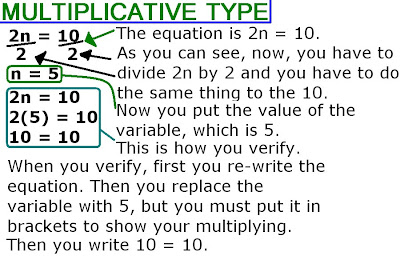
This one is about multiplication.


Finally, division.


Chapter 4

This chapter is about using algetiles for solving one step equations. I did this chapter with my friends Giselle and Linda. We explained everything on this video below.


Scribe Post November 21/08

Friday, November 21, 2008
Hey guys! Today in class we reviewed the "barn door" that shows us how to divide negative and negative integers. In the barn door that expresses us how to divide negative and negative integers we did another question. The question was 12/4.

First we had to express it in two different ways.


Next we had to make a QUOTATIVE and PARTITIVE questions and draw pictures. Quotative does not work for this question.


Quotative does not work for that question because you can not make groups of positive 4s in negative 12 and the answer for that question is 3.


For the fourth quadrant we had to do the question 6/-2, we had to express it in two different ways:

For homework we had to do questions 1-9 in the green booklet. We had to pick 6 questions that fits into our barns, draw 3 of them and do the multiplicative inverse for all of them. We also have to put the quotative and partitive sentences with the question. We have to put it in our notebooks.


Here is an answer for one of the nine questions we had to answer:


The next scribe shall be JOYSIE!

Scribe Post October 29

Wednesday, October 29, 2008
Addition and Subtraction of Integers

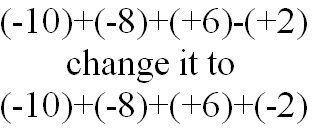
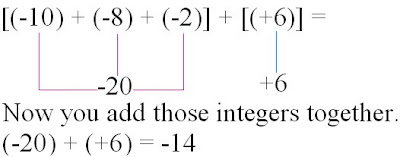
In class today we learned how to solve questions that has to do with adding and subtracting more than two numbers, like the question (-10)+(-8)+(+6)-(+2).

To solve this question you must first change the question so that all the operations are all addition.


Now you combine all the positive integers in one group and the negative integers in another group.


Now you add up the total of each group to get the answer.


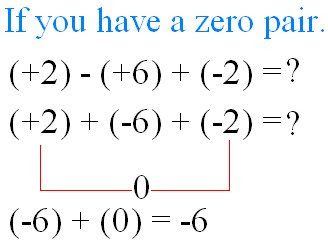
If you have a zero pair in a question like that then do this.


That is how you get the answer for this type of integer question. These are some of the questions and answers for page 48 and page 49.


These are some of the questions from page 48.


22) (-5) + (-3) - (+4) = -12


27) (+5) - (+3) - (+2) + (-1) = -3


These are some of the questions from page 49.


7) (-8) - (-3) - (-4) = -1


10)(-8) - (+5) + (+3 = -16


18) (-2) - (-1) + (0) = -1


Sorry if I did anything wrong, just comment if I did.

Bino's Quest

Friday, October 24, 2008
A guy named Bino was walking down the street, when he fell in a hole and landed in this really weird place. In this place Bino shrunk as small as an ant. Everything in that place were 20 times as tall as Bino. After Bino explored the place he saw a boy just as small as him, his name is Ted.
"How do you get out of this place," Bino asked.

" The only way you can get out of this place is if you find the King who owns this place and answer the questions he's going to ask you, the questions he's going to ask you are about integers," Ted said.
" Why do I have answer to math questions," Bino asked.

" If you don't then you will never ever get out of this place," Ted said.

Bino followed a map that Ted gave him to find the King. Finally, Bino found the King.

" Why are you here" the King asked.

" I want to get out of here," Bino said.

"I will only set you free if you answer these questions correctly," the King said.

" Ok ", Bino said.

"Here is your first question," sthe King said.

Using a number line, what is the total of (+10)+(+3). Bino said that the answer is +13.


Then the King said," That is correct, but now it's time for the next question."

"Bring it on," Bino shouted.

If the temperature starts at 20­°C, drops 6°C, rises 21°C, drops 4°C and gains 8°C. How would you write that as an expression involving integers? What is the total of this expression?

"The answer is +39," Bino said.


" That is correct, here is the next question," the King said.

You start with $300, then you earn $130, spend $120, earns $100 and spends $35. What is the sum of the money you've spent and earned?

"The answer is $245," Bino said.


"That is correct, wow I'am impressed, but we are not done yet. Here is your next question," the King said.

What is the total of (+15)+(-4)? You must answer this question with algebra tiles or else you will get it wrong.

" The answer is +11," Bino shouted.

"Very impressive, you do know your math, but the next questions I'm going to ask you are a little bit harder. I just hope that it really hurts your brain. Hahahahaha!! If you get at least one answer wrong then you will never escape my kingdom," the King said.
Here is your question. What is the answer of (-15) - (+27)?
"The answer is -42," Bino said."I can't believe that you also got that anwer right," said the King.
Well, here is your last and final question. What is the answer of (-10) + (-8) + (+6) - (+2)? You have to show me how you got the answer too.
"That is so easy, the answer is -14," Bino said.

"Ugh! You got all the anwers right which means you can now escape this kingdom of mine, but you can visit if you want," the King said.

" I'll only visit if you don't ask me anymore questions," Bino said.

"Fine I won't ask anymore questions," the King said.

"Bye," Bino said.

"Bye," the King said.

Now Bino's adventure is over, well, for now anyways.

The End

Nikki's Measures of Central Tendancy

Sunday, September 28, 2008
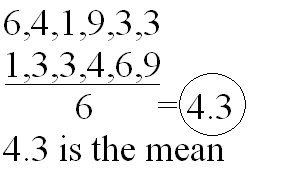
Mean

- arrange data in ascending order
- the sum of all data divided by the number of data
- with an outlier the mean is less accurate "average"


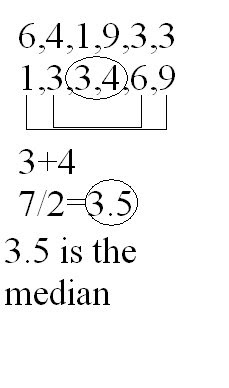
- arrange in ascending order
- find the data in the middle
- if there are 2 middle numbers you fing the mean of them
- great to use if there is an outlier


- arrange the data in ascending order
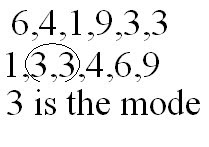
- the number that appears most in the set of data
- you can have no mode
- you can have more than one mode

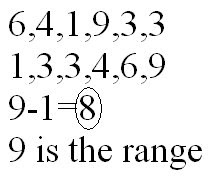
Range

- arrange the data in ascending order
- subtract the smallest data from the largest data
- large range= outlier
Here is a video I found on mean, median and mode.