Adding fractions can be confusing if you don't understand it. But, it can actually be quite simple if you do understand it. An example of adding fractions is 5/7 + 1/2:
To add fractions, you find the common denominator. Then, to find out the numerator, you cross multriply (it's the easiest way)
Another example of adding fractions is 5/9 + 1/3.
One last example on adding fractions is 10 1/2 + 6 4/5.
For subtracting, I'll use 3 3/8 - 2 3/4 as an example.
Subtracting fractions is basically the same as adding them; the rules still apply. But when you have a mixed number, you change it into an improper and subtract from there.
* To convert a mixed number into improper, multiply the whole number by the denominator and add the numerator.
Multiplying Fractions
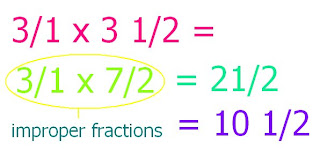
Multiplying fractions is pretty straight forward; just multiply the numerators together and the denominators together. Simplify if possible. An Example is 4/5 x 1/2.
The next example contains a mixed number. All you have to do is convert the mixed number into an improper fraction, multiply, and then convert it back into a mixed number as your answer.
Dividing Fractions
Ask yourself the question "How many groups of __ are in __?" when dividing fractions. I'll explain how to divide fractions by using a ration table.
Example: 3/4 / 1/3.
Word Problems
Fifteen scoops of flour makes 6 2/3 cakes.
This question is pretty self-explanatory; all you have to do is multiply how many hours of daylight by the period of how long it was sunny.
Today, we were assigned yet another blog post. We have to define the word reciprocal, explain how it's used in math, use reciprocal in 2 questions (3/4 divided by 2/5 and 2/5 divided by 3/4) and guess if it's either more than or less than one.
Definition:
In mathematics, the reciprocal can be referred to multiplicative inverse. When 1 is divided by x, multiplied by x, it will give the product of 1.
In general, the fraction's reciprocal is attained by alternating the numerator and the denominator.
How is it used in math?
Using reciprocal is easier and quicker than dividing the fraction. It's used when you are doing ratio tables. We use the denominator to multiply the fraction, then divide it by the numerator to make a whole number.
Guesstimate:
3/4 / 2/5. I think it's more than 1.
2/5 / 3/4. I think it's more than 1.
Examples:
3/4 divided by 2/5.
As you can see, we used reciprocal to get a whole number; we used the denominator (5) to multiply the fraction, then divided it by the numerator (2). What you do on one side of the ratio table, you have to do the same thing to the other. But, we weren't able to divide so we had to figure out how many times does 4 goes into 15. Then you'll have your answer.
Again, we did the same thing as the first question.
Today, Mr. Harbeck assigned us 7 questions for multiplying fractions. We had partners, and we had to create a post explaining our answers.
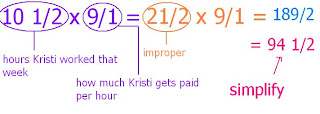
6. One week, Kristi worked 3 days at a department store for 3 1/2 hours each day. She was paid $9/hour.
a) How many hours did Kristi work that week? Show your thinking.
To get the answer, multiply how many days she worked by how many hours she worked each day.
Kristi worked 10 1/2 hours in that week.
b) How much did Kristi earn that week?
Kristi earned $94.50 that week.
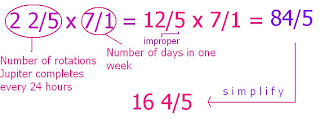
7. Jupiter completes about 2 2/5 rotations every 24 hours (an Earth day). How many rotations does Jupiter complete in one week? Show your thinking.
To get the answer, you multiply the number of rotations Jupiter completes every 24 hours by the number of days in a week.
Jupiter completes 16 4/5 rotations in one Earth week.
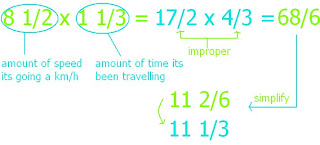
8. A sailboat is sailing at 8 1/2 km/h. If the weather conditions and the current do not change, how far will the sailboat travel in 1 1/3 h? Show your thinking.
To get the answer, you multiply the amount of speed its going a km per hour by the amount of times to been travelling.
The boat will travel 11 1/3 km in 1 1/3 hours.
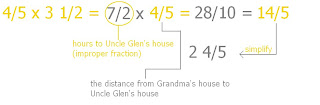
9. The distance to Grandma's house is 4/5 of the distance to Uncle Glen's house. If Uncle Glen's house is 3 1/2 hours away, how long will it take to get to Grandma's house if you travel at the same speed?
To get the answer, multiply the distance to Uncle Glen's house to Grandma's by how many hours away Uncle Glen's house is.
It will take 2 hours and 48 minutes to get to Grandma's house.
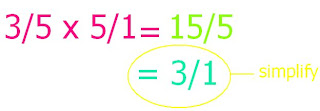
10. It takes 3/5 of a tank of gas to get to work and back each day. How much gas is used over 5 work days? Show your thinking.
To get the answer, you multiply the the fraction of how many gas is used in one day by how many days it is used for.
3 tanks of gas are used over 5 work days.
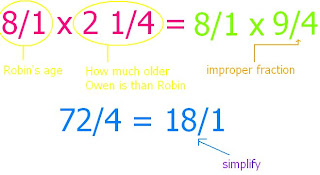
11. Owen is 2 1/4 times as old as Robin. When Robin celebrates his 8th birthday, how old will Owen be?
To get the answer, you have to multiply Robin's age (8/1) by how much older Owen is than Robin (2 1/4).
On Robin's 8th birthday, Owen will be 18 years old.
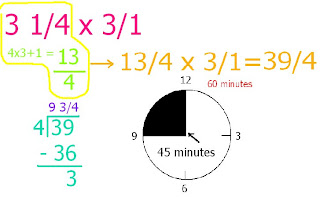
12. The karate club is arranging a grading for its members. It takes 3 1/4 hours to test a group of 4 candidates. How long will the club need the gym in order to process 3 groups of 4 candidates each?
To get the answer, you have to multiply how many hours it takes to test a group of 4 by how many groups are there in total.
It will take the club 9 hours and 45 minutes to process 3 groups of 4 candidates.
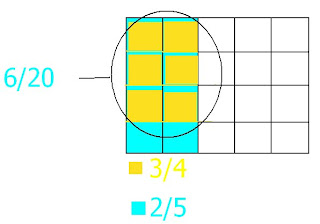
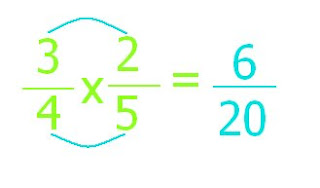
For our third post for math skills, we were assigned to explain if 2/5 of 3/4 are the same as 3/4 of 2/3.To find out, I am going to use pictures and multiplication.
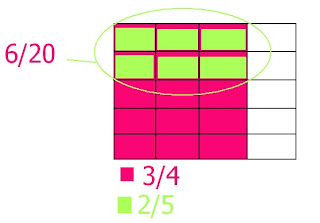
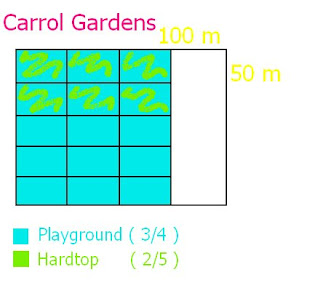
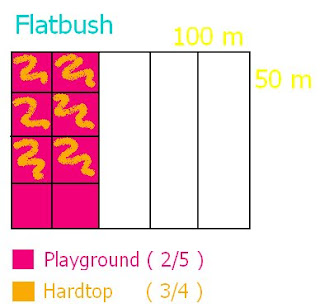
Sorry if I created my post 2 days later, but on Thursday we were assigned a question. The question was to see which park had more hardtop than the other (Carrol Gardens and Flatbush). The information contained that 3/4 of Carrol Gardens will be playground; 2/5 of the playground will be hardtop. For Flatbush, 2/5 of the lot will be playground; 3/4 of the playground will be hardtop. Both of the parks are 100m x 50m. Is one neighbourhood getting more than the other?Well, let's draw a picture.
Carrol Gardens:
If you divided Carrol Gardens into fourths of the park and colour 3/4 of it, that will be your playground. Then if you divided the playground into fifths and colour 2/5 of it, that will be your hardtop. The hardtop is 6/20 of the park.
Flatbush:
If you divided Flatbush into fifths and colour 2/5 of it, that will be your playground. Then if you divided the playground into fourths and colour 3/4 of it, that will be your hardtop. The hardtop will also be 6/20 of the park.
As you can see in the pictures, you'll have the same amount of hardtop. So, to the answer of my question... no, one neighborhood is not getting more hardtop than the other.
If my answer is incorrect, please feel free to correct. :)
Sometime last week, we were assigned another assignment in Skills class. But instead, we have to make a post about subtracting fractions that should borrow, and fractions that should use improper.
The proper time to borrow is when you need to subtract the two fractions but need to use the whole number to do so or when the number is simply big. For example 12 2/11 - 4 9/11. I will explain to you by using pictures, step by step.
The proper time to make a fraction into an improper fraction is when the first fraction cannot be subtracted by the second fraction. For example, 6 1/2 - 1 3/4.
Now that we've subtracted the whole numbers, we need to subtract the fractions. In order to do that, we have to firstly find the common denominator. Both of the denominators fit into 4 equally, so our equivalent fractions are now 2/4 and 3/4. 3/4 stays the same because the denominator is already 4.
* To get an equivalent fraction, you have to see how many times the first denominator goes into the new denominator. Then you have to multiply how many times by the numerator. (E.g. 1/2: 4 is the new denominator. 2x4=2. 2x1=2. New fraction is 2/4.)
After you've changed the fractions, you still can't subtract but that's how it's supposed to be. So the next thing you need to do is multiply the whole number with the denominator and add the numerator (just like when you're borrowing).
Finally, all you have to do is subtract the fractions and you'll get the answer.
This week, we began our new topic: fractions. During math skills, we were asked to compare fractions. There are two ways to compare; by using pictures and decimals. By comparing fractions with pictures, you are able to see the amount of pieces and which represents the numerator. When you compare fractions with decimals, you compare them by using the place values. For example, compare 2/3 and 4/6.
Decimal:
In order to get the decimal from the fraction, you divide the numerator by the denominator. If you divide 2 by 3, you will get 0.666667. If you divide 4 by 6, the answer will also be 0.666667. It's the same, so the fractions are equivalent.
Picture:
Clearly, 2/3 and 4/6 are equal. But they're not the same. For example, if you were to have 3 friends over at your house, and you wanted to eat pie. You cut the pie into sixths, and you take 4 pieces for you and your friends. Your mother comes into the kitchen and says, "2/3 of the pie is gone, who ate the pie?" You would've said, "No mom, my friends and I ate 4/6 of the pie." They're not the same because 4/6 would've been more precise.
Another example is 1/8 and 1/4; are they less than, greater than, or equal to? Let's find out.
Decimal:
Again, divide the numerator by the denominator. If you divide 1 by 8, you will get 0.125. If you divide 1 by 4, the answer will be 0.25. But which is more? Like I said in the beginning, you find out by comparing the place values.
As you can see, 1/8 is less than 1/4, because 1/4's tenth and hundredth places are bigger than 1/8's tenth and hundredth places. The extra 0's do not affect the decimal, it's there to be more precise.
Picture:
As you can see, 1/4 is obviously greater than 1/8. Both fractions have 1 as a numerator, which is very helpful when it comes to comparing fractions as well as ordering them. When 1 is the numerator, the fraction is called units. It's easier to compare and order them because the smaller the denominator is, the bigger the fraction. So, 4 being a denominator is bigger than 8 being a denominator.
This week, we were assigned to learn about Pythagoras' theorem. We were given important vocabulary that would help us figure out how these artifacts are linked together.
Hypotenuse - the longer side of the triangle. The hypotenuse is on the opposite side of the right angle.
Legs- are the shorter sides of the triangle.
R.A.T.- Right Angle Triangle.
Theorem - a² + b² = c² is Pythagoras' theorem. A theorem is a demonstrated statement that has been proved or needs to be proven.
Greek - A native or citizen of Greece.
This is Pythagoras. Pythagoras was a Greek mathematician who was uber smart. He lived 2500 years ago and died at the age of 90. He is the one who came up with the theory of a² + b² = c². He is important because his mathematical theories and formulas are still used today.
This shape is a right angle triangle (R.A.T.). The shorter sides are called the legs ( a and b). The longest side, across the right angle, is the hypotenuse. The hypotenuse is c. The formula for a right angle triangle is a² + b² = c². a can either be the vertical line, or the bottom line. The same goes to b.
As you can see, this square has all equal sides because there are lines going through it.Each corner is 90 degrees. The whole square equals to 360 degrees.
All these artifacts are linked together because they prove Pythagoras' theorem.
Problem 1
This is a board game and we need to figure out what the perimeter. To do this, we first have to square root the square because it's equal on all sides. You get 15. As you can see, there are lines going through the triangle. That means its equal and the sides of the square are equal to the legs. So that obviously means that the legs and the sides is 15. Now, we have to figure out the hypotenuse. As we now know, Pythagoras' theorem was a² + b² = c². Like I said earlier, the a or b can be either the vertical line or the bottom line.
The question is now 15² + 15² = c².
² just means a number times itself.
(15x15) + (15x15) = c²
225 + 225 = c²
450 = c²
Then, you have to use square root. After you square root, you end up with 21.213. That is the the answer to c². So, the hypotenuse is 21.213. To know if you are right, the hypotenuse is always the higher than the legs.
Here is me and Sharmayne's video on explaining c² - b² = a². We don't have the video of us doing a² + b² = c² because we accidentally deleted and uploaded the wrong video. But, enjoy!
Well, I kind of forgot to do the scribe post for yesterday. But, here it is. :)
Yesterday was the first day back and we got a newpurple booklet. We also got new barn doors. We learned one step equations that were additive type and subtractive type. Mr. Harbeck mentioned that algebra is a balancing act. Whatever you do to one side, you have to do to the other side. For example, n+7=10.
HOW DO WE MAKE IT BALANCED?
First, you need to:
Isolate the variable
Cancel using the opposite
Balance
Verify
Subtractive Type
The rules still apply, but now you're subtracting. For example, y-13=-5.
the "Rule of Multiplying Integers". People went in front of the class to say the rule, I thought, when will it be my turn?
Anticipation was running through me Just like a car driving through quickly.
I just wanted to show that I knew the rule Minutes passing by.. it was cruel.
The teacher finally picked me
And everyone was going to see.
I said, "When brackets kiss, you multiply. Trust me, it's easy as pie!"
I went to sit down at my desk, Realizing I was missing the rest. Next thing I know, Someone else was walking up in between the rows.
"When you multiply an odd amount of integers, your answer is negative, Sir."
They were still missing something I felt like the wife of a King. I still had a chance to show everyone what I got I went up there again, faster than a yacht. "When you multiply an even amount of integers, your answer is positive and that's for sure!"
I was happy to be the last one to say the final rule of multiplying integers and surprisingly it was fun.
Haiku: Quotative Division
Ask a division question
Say, "How many groups are in...?"
Simplicity, see?
Tanka: Partitive Division
What is partitive?
It is just like quotative
Just like dealing cards
All you have to do is share
It's easy, not hard at all
CHAPTER 2: Combining like terms and the Distributive Property
Script:
Roxanne: Hello! How have you been lately?
Joanna: Hey! I've been great, and you?
Roxanne: Just fine. Although, I have been struggling with my math lately. That's why I called you over.
Joanna: What do you need help on?
Roxanne: Well, my class and I are learning algebra.
Joanna: Algebra? Algebra is my favourite topic in math!
Roxanne: Okay, so my first question on the worksheet is n+3-5n+12. Do you think you can help me?
Joanna: Yes, I can help you. But, first of all I want you to try this question out. What do you think the answer is?
Roxanne: Uh, I think the answer is -6n+15. Am I right or wrong?
Joanna: Actually, your answer is really close. It's -4n+15.
Roxanne: How do you get the answer?
Joanna: It's quite simple. First of all, you should circle the variable so you know which goes first. Then, group like terms so it's easier. Now, simplify the question. So, it would be n-5n+3+12. Also, n just means 1. n-5n=-4. 3+12=15. Put them together and you've got -4n+15.
Roxanne: Wow, that's easy! Thanks for the help! I think I can manage on my own. You can stay if you want.
Joanna: No problem, but I still have to finish up with my chores. Just call me when you need help and I'll be here in a jiffy. Well, I'm going to go home now. Bye!
Roxanne: Wait, Joanna! The next questions has brackets.. I know I'm suppose to multiply, but what do I multiply?
Joanna: What's the question?
Roxanne: The question is 2 + 4(3n+8).
Joanna: Okay, it'll be easy just like the first question! This is called Distributive Property. It looks tricky, but once you know what to do you'll think "Boy, that was super easy!"
Roxanne: Distributive Property... Can I try this question on my own first?
Joanna: Sure, it's best to learn from your mistakes, anyway. But, tell me how'd you got the answer.
Roxanne: I think it's 12n+10. First of all, I knew the rule of multiplying integers. So, I just multiplied whatever was touching the bracket. That's how I got 12n. I didn't know what to do with the other two numbers, so I just added them together.
Joanna: Ah.. Well, I can tell you didn't know what to do with the 2. For now, just pull the 2 down. Now multiply the 4 and 3n together, which is 12n. After that, multiply the 4 and 8 together, which is 32. Now, the question is 2+12n+32. All you have to do is combine like term and simplify. So, it will be 12n+2+32. You see, I combined the integers that didn't have variables and I combined integers that did. It makes it way less confusing when you combine like terms. Now, finally... the answer is 12n+34! Very simple, like I said. Well, I probably should get going. My mom might be wondering what's taking me so long. See you later, Roxanne!
Roxanne: Oh okay and thanks! Bye, Joanna!
CHAPTER 3: One Step Equations Solving
We've been learning one step equations in addition, subtraction, division and multiplication. First, I'm going to show you how to do an additive equation. But, before we do that, there are some 'rules' you need to learn in order to be successful with one step equations.
ADDITIVE
The first question is n+9= -4. As you can see, I've isolated n by using the opposite of +9 (which is obviously -9). Like I said, what you do on one side, you have to do the same thing on the other side. So, I put -9 beside -4 to balance it out. You're left with n= -13. That is how you solve n. Now, you have to verify so you can get full marks.
SUBTRACTIVE
The rules are basically the same as additive equations. Isolate to get n by using the opposites, balance and verify.
MULTIPLICATION
The question is 2n=10. Again, the rules still apply to multiplication as well. When you're isolating n in a multiplication equation, you divide since you need to cancel them out. Do the same thing to the other side. You have to figure out what 10/2 is in order to get n. n=5. Verify.
DIVISION
Finally, division. In this question, there is a negative sign. You can just easily put the negative sign beside the 9 or the n. In this case, I've decided to put the negative sign beside the 9 because it's a bit easier. After that, you do the same thing again as the rest of the questions we did. You have to multiply to isolate n when you're doing a division equation. Do the same thing to the other side. Figure out what 4(-9) is. n= - 36. Verify. Now you know how to do one step equations!