Well, I guess that is it because Mr. Harbeck told me to do the first 4 questions! (: Anyways.. yeeaah, BYE & comment like crazy! Oh right , and the scribe for monday is .. KEVIN ! haha. >x)
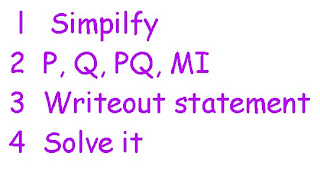
Yeah... It's due tomorrow. Both SIDES should be done if you want a good mark... For example the ++ side should have these things:
MATH HOMEWORK
(Sigh...) We have some homework to do. We had to do the rest of page seven (question 19 and 23) Don't do the questions with exponents! Also We have to do question 1-15 on page 8. Here is one of them....
13 on page 8. The answer is 23...( I think...) please correct me if I'm wrong...
Oh! There is a QUIZ tomorrow too!
Don't forget to study! here are some of the questions on the quiz!
Hey guys! Today in class we reviewed the "barn door" that shows us how to divide negative and negative integers. In the barn door that expresses us how to divide negative and negative integers we did another question. The question was 12/4.
First we had to express it in two different ways.
Next we had to make a QUOTATIVE and PARTITIVE questions and draw pictures. Quotative does not work for this question.
Quotative does not work for that question because you can not make groups of positive 4s in negative 12 and the answer for that question is 3.
For the fourth quadrant we had to do the question 6/-2, we had to express it in two different ways:
For homework we had to do questions 1-9 in the green booklet. We had to pick 6 questions that fits into our barns, draw 3 of them and do the multiplicative inverse for all of them. We also have to put the quotative and partitive sentences with the question. We have to put it in our notebooks.
Here is an answer for one of the nine questions we had to answer:
In today's class we got a review of how to divide positive and positive integers. If you scroll down, you can see Karen's scribe to get a re-cap. In our barns we learned about dividing negative and positive integers. The question we started off with was: The answer to this questions is -3 but how can we solve this question with the Quotative and the Partitive?
For the Quotative it is asking us: How many positive twos are in negative six? As you can see, it is all negatives. If your thinking zero pairs, you are wrong. We do not need zero pairs for this because we are already given negative six.
So how do we solve this question?
The Partitive asks us: How many equal parts are in 2 groups when we have -6? See? The answer is -3 which is exactly what we needed. Remember that the Partitive is just like dealing cards in real life because we have to deal the cards equally to each person. So in short, using the Quotative will not give you the answer for dividing a negative and positive integer.
Our homework is to put the quotative or partitive to solve -6 *divided by* -2 on the negative (--) negative boxes of The Barn.
Today in class we started learning about dividing integers. Mr. Harbeck and Mr. Backe (sorry if I spelt it wrong) taught us dividing positive integers. We flipped our 'barns' to the white side which is division.
We did the positive positive side (++). The question is: This question can be said in 2 ways. 1st way: (QUOTATIVE) How many 2s are in 6? 2nd way (PARTITIVE) How many equal parts are in 2 groups when we have 6?
ANOTHER WAY YOU CAN WRITE THIS QUESTION:
QUOTATIVE:
PARTITIVE:
Here's a video about dividing integers.
That's what we did in math today. Homework for Mr. Backe ( and again sorry if I spelt it wrong ): ) is to think about this question- ___x 2 = 6
In class today, we didn't do very much. We were given a quiz consisting of 10 questions. We were all instructed to show our work. Since we were to hand in the quiz following the completion, I cannot talk about each of the questions. But what I will do is refresh your eager minds about boxing (the "Green" way, and "Blue" way), adding integers, and subtracting integers. I will, because that's what the math quiz that we did was all about.
Do you remember how to add integers? Hopefully, you do. Here is a very simple example. (+2) + (+3) Since the integers are both positive, you would use standard math to answer this question. Although, standard math is probably the ideal method to use, but there are other ways to solve questions such as these, as well. The other methods are using integer tiles, number lines, and have and owe. So, did you figure out the answer ? Yup, I knew you did. The answer is (+5)
Now, let's see if you remember subtracting negative integers, shall we? Here is a simple question. Try solving it. Keep in mind, you never really subtract. When you see a negative sign, you switch the sign to a negative, and the next integer sign to the opposite sign. (+2) - (+3) (+2) + (-3) When subtracting integers, it is useful to use a number line. Remember, a number line has a ZERO in the middle, and infinite positive numbers to the right, and infinite negative numbers to the left. When subtracting integers, you would move that many places to the left. The same rule applies to adding positive integers, except you would move to the right, instead of the left.
Alright now, we should remember this number line method by now. Below, is the Have and Owe method.
Now, I'll be talking about the recent things we have learned, which is multiplying integers. Remember, when the brackets are touching, they multiply! Keep in mind the ROOM 17 Theorem ! "When you multiply an odd amount of negatives, the product is always negative" (the amount of positives in the question won't affect the product)
When you multiply a negative, and a negative, the product is always positive. When you multiply a positive, and a negative, the product is always negative. When you multiply a positive, and a positive, the product is always positive. When you multiply a negative, and a positive, the product is always negative.
Here is a fairly simple example. (2)(-3) = (-6) The answer is (-6) because a positive and a negative equals a negative, and 2 multiplied by 3 equals 6.
Now, I'll talk about boxing, the BLUE way. Here is an example using brackets.
Now, I hope that the picture above is helpful to you all. Using the "blue" method, you box out the group of integers, that you will multiply. In the group of integers, you multiply the integers to get 1 answer. Then, once you have your answers for the boxed out integers, you bring down the order of operations.
Now, I'll talk about the Green method. Using the green method, you put a (1) by the order of operations, if its an adding sign. You put a (-1) if its a subtraction sign. Below is a picture explaining the who "Green Method" idea.Sorry if I did the Green Method wrong. I wasn't absolutely sure how to do it... Karen, I choose YOU ! (as the next scribe) ---------------------------------------------------------------------- Here is a video of adding integers
Today Mr. Herbeck isn't here so he made a video on the http://www.sargentparkmathzone.blogspot.com/ . Today we only need to check are last test in Math class. On the video that Mr. Herbeck made, he was telling us how to do the new multiplying Integers. Today I'm going to show you how to do in 2 ways.
[2 Ways]
Integer question in use - (-4) (-1) (-2) - (1) (6) (3) + (-4) (-5) (-3) =
Way number 1:
Sorry if my answer is wrong =[
Way number 2:
Again, sorry if this confuse you.
Another Thing after this explaining:
After When Mr. Herbeck told us how to do the questions, we got are test back to check. After when your done checking are test, Mr. Herbeck said Correct your answers on the video. Like if you get this answer wrong you can correct it.
Homework:
Today Homework you have to do the Green book 6 and the yellow book 51. You also have to show your work. Green book do the whole thing 1 - 18. Also on the yellow book, I think your suppose to do all of it.
Today, we learned new stuff in Math and lets go over it! Now for some new stuff.. (2)(-3)+(2)(-3)=?? Now lets solve this question.Now for another question. (-2)(3)+2(-3)-6(1)+(3)(4)=?? Remember to solve the brackets first and pull down the order of operations after. And that's what we did in Math! For homework you need to work on the questions 1to7 on page 6. I PICK VINSANE FOR SCRIBE ON MONDAY
Today in math class we went over some homework. One of the questions we did was this one:
(-5)(-4)=
This means take away five groups of 4. Since you cant take away 5 groups of negitive 4 you have to make zero pairs.
Once you take away five groups of zero pairs it should look like this:The answer is 20.
Now for todays work. We went over some rules on multiplying integers. Here are those rules.
When you multiply an even amount of negitive integers the product is always a postive product. Another one is when you multiply an odd number of negative integers the product is always a negitive product.
eg.
Homework for today.
Todays homework we had toProve the room 17 theorem with questions 13-18 in the green book. This is what I did. Well I just answered all the questions. I didn't really get this homework, but I tried.
Today in class we talked about multiplying integers again. But instead of adding more things to our booklet with two sides on it, we were assigned to do some practice on it. For our practice, we had to page five, questions one to twelve, and what patterns we see on questions thirteen and fourteen. We also had to pick four questions out of the 12 questions that we had to do and draw a diagram to support our answer. Then we were asked to make a rule on what the product will be when we multiply certain integers together. It kind of looked like this....
Make a rule!
When I multiply.....
1.(-)(-)= 5.(+)(-)=
2.(-)(-)(-)= 6.(+)(-)(-)=
3.(-)(-)(-)(-)= 7 .(+)(-)(-)(-)(-)=
4.(-)(-)(-)(-)(-)=
If you can't figure out what it is these are the answers.
1. + 2. - 3. + 4. - 5. + 6. + 7. -
These are some of the questions and answers for the questions in the green booklet.
1. (3)(9)=27
This question equals to this answer because the answer is just simply saying what is 3 times nine.
2. (-11)(4)= (-44)
This question equals to this answer because a negative times a positive always equals a negative product. So the first thing you do is multiply eleven and 4 together and then change that answer into a negative answer.
3. (-4)(-12)=48
This question equals to this answer because a negative multiplied by a negative will always become a positive product. The first thing that you do to solve this question is change the negative integers into a positive integer and then multiply.
4. (8)(-8)=(-64)
This question equals to this answer because when you multiply a positive integer to a negative you will alwaysd get a negative product. To solve this question all you have to do is what i said in question 2.
5. (6)(-2)=(-12)
This question equals to this answer because of what i said in question 4.
Hello again everyone! I'm the scribe for November 5, 2008 (as the title also states). In today's class we had a guest teacher in the room, Mr. Backe. While he was asking us what we were learning in class and what we knew about the topic, (as if he didn't already know) Mr. Harbeck was handing out giant blue and white papers. Mr. Backe then instructed us on how to actually fold the papers into the shape you'll see below. He also told us to write positive and negative signs on it just like a coordinate grid.
He then told us what the paper was for. It's going to be used to write things we learn about multiplying integers and later dividing them on the white side...the back which you can't see. After all this we started to write things on the actual piece of paper.
You probably can't see those things up there so I'll tell you what the open flaps say. The two middle ones were homework but we'll get to that later.
On the right flap (the positive, positive flap) we wrote the question (+2)(+3)= and underneath wrote When the brackets touch they multiply (in Mr. Harbeck's words they kiss and then multiply). After that we solved the question by figuring out what the question is saying. It was saying 2 groups of (+3). Then we wrote that next to the question in algebra tiles. Afterwards we put the answer to the question after the equals sign (as we always do). There's a picture of it all below if you're too lazy to read this....
Then we had to write something on the left flap (the negative, positive flap). We wrote the question (-2)(+3)= and underneath wrote This question says... Then underneath that we put the words Remove two groups of (+3) because when you have a negative first it means remove. Next, under remove we put (-) and under two we put 2. After that we put algebra tiles under it. There's a picture for it all...don't worry.
That's all we did in class today...yes, it was a relatively easy class...except for...
Homework
Don't cry! It's easy. All you need to do is make up a question like the ones on the flaps but this time you write them on the insides (what's under the flaps when your paper is closed).
That's all for today so...goodbye! Oh! Except for who's the next scribe. The next scribe is Carlo (he asked so...his wish is my command I guess)!
In today's class, we learned how to add and subtract integers in standard form. In standard form we combine integers. For example, -4-3= -7. It's owe 4, owe 3. As you can see, there are no more "training wheels". You also DON'T add the opposites.
Then when do you add the opposites? You add the opposite when there are two "owes".
To get the answer in less confusing way, just collect them together or group like terms.
For today's homework, we got a new booklet that's green. On the first page, we do all the questions in part one and all the even numbers in part two.
PART ONE 1. 6+8= 2. -4-3= 3. 15-2= 4. 14+8= 5. 9-23= 6. -5-8= 7. -12+25= 8. -11+12= 9. 22-8= 10. -7-8= ... and so on.
PART TWO 2. 5-(-8)-(7)+5= 4. 5-2-(-7)-(-3)= 6. -7-(-5)-(-7)-8= 8. -7-(-5)-(5)+8= 10. -(-2)-(-6)-15= 12. -2-3+4-6= 14. 2-7-8= 16. 3-9+8= ... and so on.
Sorry if I didn't explain well or didn't make sense. If I'm wrong, just comment. :)



 In the barn door that expresses us how to divide negative and negative integers we did another question. The question was 12/4.

 For homework we had to do questions 1-9 in the


 The answer is 20.


 For today's homework, we got a new booklet that's

